

Multi-Agent Systems: How Orchestration Is Changing Enterprise Software
Single-agent chatbots are giving way to orchestrated systems of specialized agents. Here's what that shift actually looks like under the hood, and why it matters.
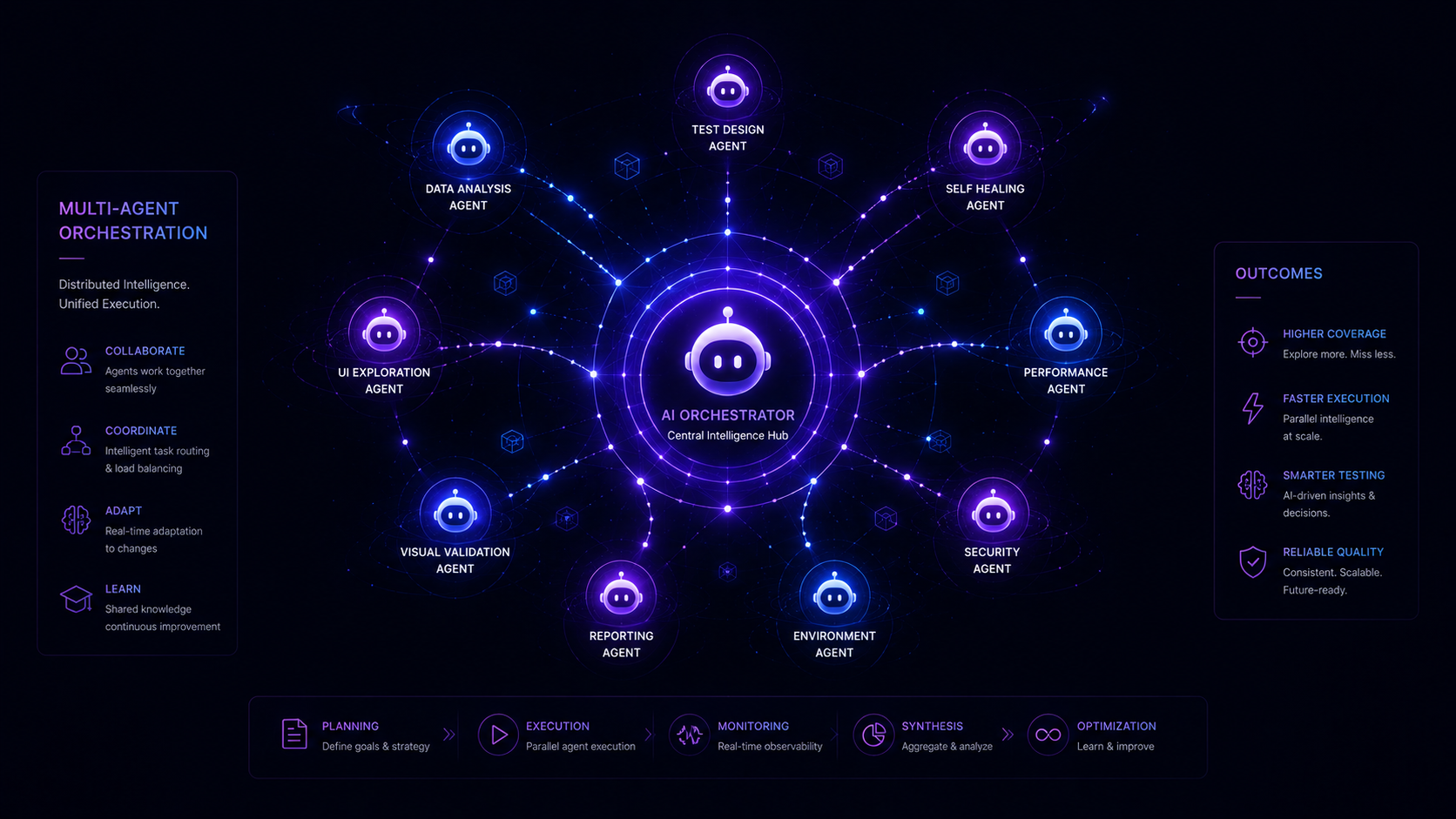
From one generalist to many specialists
Early AI deployments tended to reach for a single agent to handle an entire workflow — one model, one prompt, doing everything from understanding intent to executing the task to formatting the response. That works for narrow use cases, but it breaks down fast as the scope of a workflow grows, because a single agent has to be good at everything simultaneously.
The pattern that's replacing it is orchestration: a set of narrowly scoped agents, each good at one thing, coordinated by a routing layer that decides which agent handles which part of a task, similar to how a well-run team divides work by specialty instead of asking one generalist to do it all.
What orchestration actually solves
Specialization makes each individual agent easier to test, evaluate, and improve, because its scope is small enough to reason about precisely. It also makes failures more legible — when something goes wrong, you can trace it to a specific agent and a specific step, instead of debugging one enormous prompt that's quietly doing six jobs at once.
It also opens the door to running agents in parallel. A research agent can be gathering information while a drafting agent works on structure, cutting total task time in ways a single sequential agent can't.
The coordination problem
The hard part of multi-agent systems isn't building individual agents — it's the orchestration layer that decides what to do when agents disagree, when a sub-task fails, or when the plan needs to change mid-execution. Systems that skip this and just chain agents together linearly tend to compound errors: a wrong output from an early agent gets fed as trusted input to the next one.
The systems that hold up in production build in verification between steps, not just at the end — checking an agent's output before it becomes another agent's input, the same discipline you'd want between any two teams handing off work.
Want to see this in production?
Talk to us about Chief Voice, X-Suite, or a custom-built AI solution for your business.
Talk to Sales